
Women's Health · Dermatology
It's Called Intertrigo. Here's Why Nothing You've Tried Has Worked.
The under-breast rash that affects millions of women has a name, a cause, and a treatment that works differently from everything you've tried.
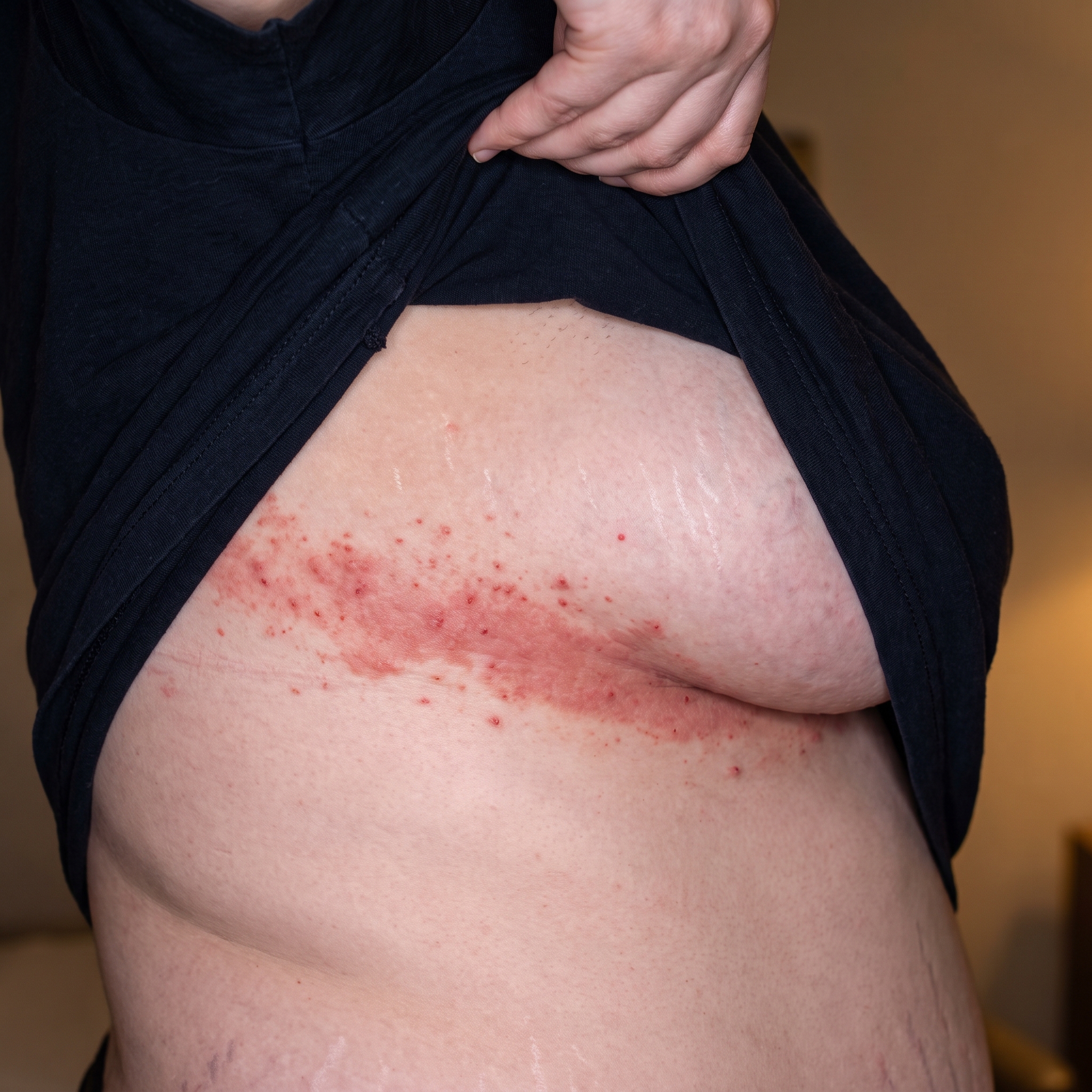
The persistent rash under your breasts — the one that burns, cracks, and won't go away no matter what you try — has a name.
It's called intertrigo.
And the reason nothing has worked isn't your hygiene, your weight, or anything you're doing wrong. It's that every product you've used — every powder, every cream, every prescription — was designed for a completely different part of the body. A forearm. A shin. Skin that's exposed to air.
The skin under your breasts isn't exposed to air. It's a sealed fold: warm, dark, moist, with skin pressed against skin around the clock. The treatments you've been using were never built for that environment. That's why they work for a few days and fail. Every time.
If that pattern sounds familiar — a product that helps for a week and then the rash comes back worse — what you're about to read will explain exactly why.
You're not alone
Intertrigo affects millions of women. It has nothing to do with cleanliness.
Thin women. Heavy women. Women in their thirties. Women in their sixties. Women who've just had a baby. Women who've lost weight and now have loose skin that creates new folds.
A woman who showers twice a day can develop intertrigo. A woman with impeccable hygiene can develop intertrigo. Because the problem isn't what's on the skin — it's what the skin fold creates: a sealed environment where moisture can't escape.
Most women who have it don't know its name. Their doctors may have called it a "heat rash," a "friction rash," or simply "irritation." Some were told to "keep the area dry" — without being told why that's nearly impossible in a sealed fold, or what's actually causing the rash in the first place.
If you've spent months or years thinking something is wrong with you, it's not. Something is wrong with the treatments you've been given.
What's actually happening
Intertrigo is a fungal infection. Most women don't know that.
The organism responsible — most often a yeast called Candida — thrives in warm, moist environments with no air circulation. A skin fold under the breast is exactly that environment. Sealed, dark, body-temperature, moist from perspiration that has nowhere to evaporate.
The fungus doesn't just sit on the surface. It builds a biofilm — a microscopic shield that protects it from whatever you apply topically. Think of it as a transparent barrier the fungus constructs over itself. Surface-level treatments hit the biofilm. They don't penetrate it. The infection underneath stays intact.
This is why the pattern is always the same: you apply something, the rash improves for a week, maybe two — the surface layer of fungus dies — and then it returns. Because the biofilm-protected colony underneath was never reached, and the warm, moist environment that feeds it was never changed.
The rash — the redness, the cracking, the burning — is your body's inflammatory response to the fungal colony. The smell is a byproduct of fungal metabolism. Neither is a hygiene issue. Both are symptoms of an infection living in an environment perfectly suited for its survival.
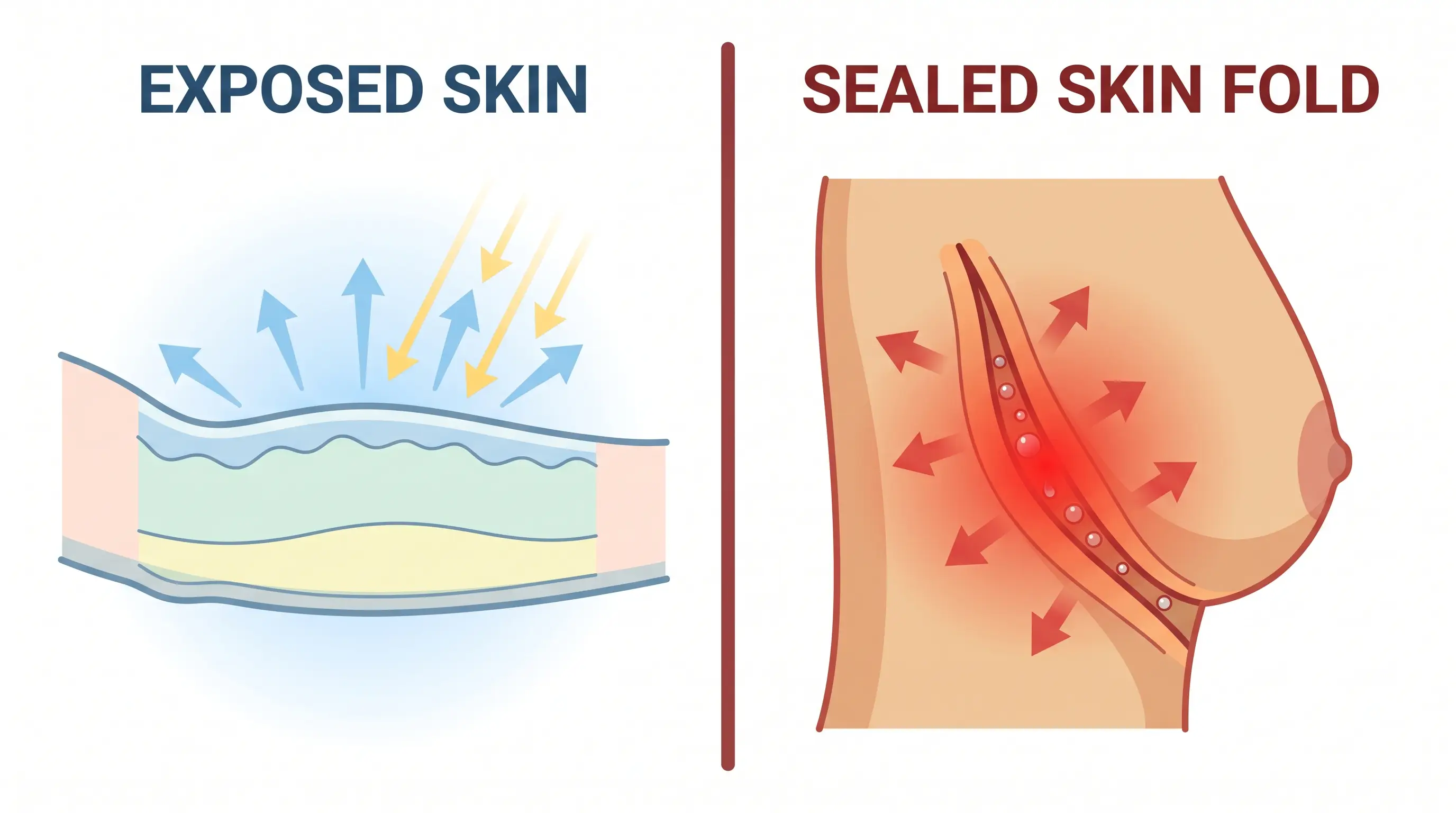
Left: exposed skin (arm, leg) — air, light, evaporation. Right: sealed skin fold — heat, moisture, no airflow. Same treatment, completely different outcome.
The Treatment Problem
Why every product you've tried has failed in a skin fold.
With that understanding, every product you've tried starts to make sense — and so does its failure.
Baby powder and Gold Bond absorb moisture for roughly 90 minutes. Then body heat and perspiration turn the powder into paste. The dry barrier becomes a moist film trapped against the skin. The fungus was never treated — just temporarily dried on the surface.
Cornstarch is worse. Candida is a yeast. Yeast metabolizes starch. Using cornstarch in a skin fold is, quite literally, feeding the organism responsible for the rash. Many women use it on the recommendation of forums or family members without knowing this.
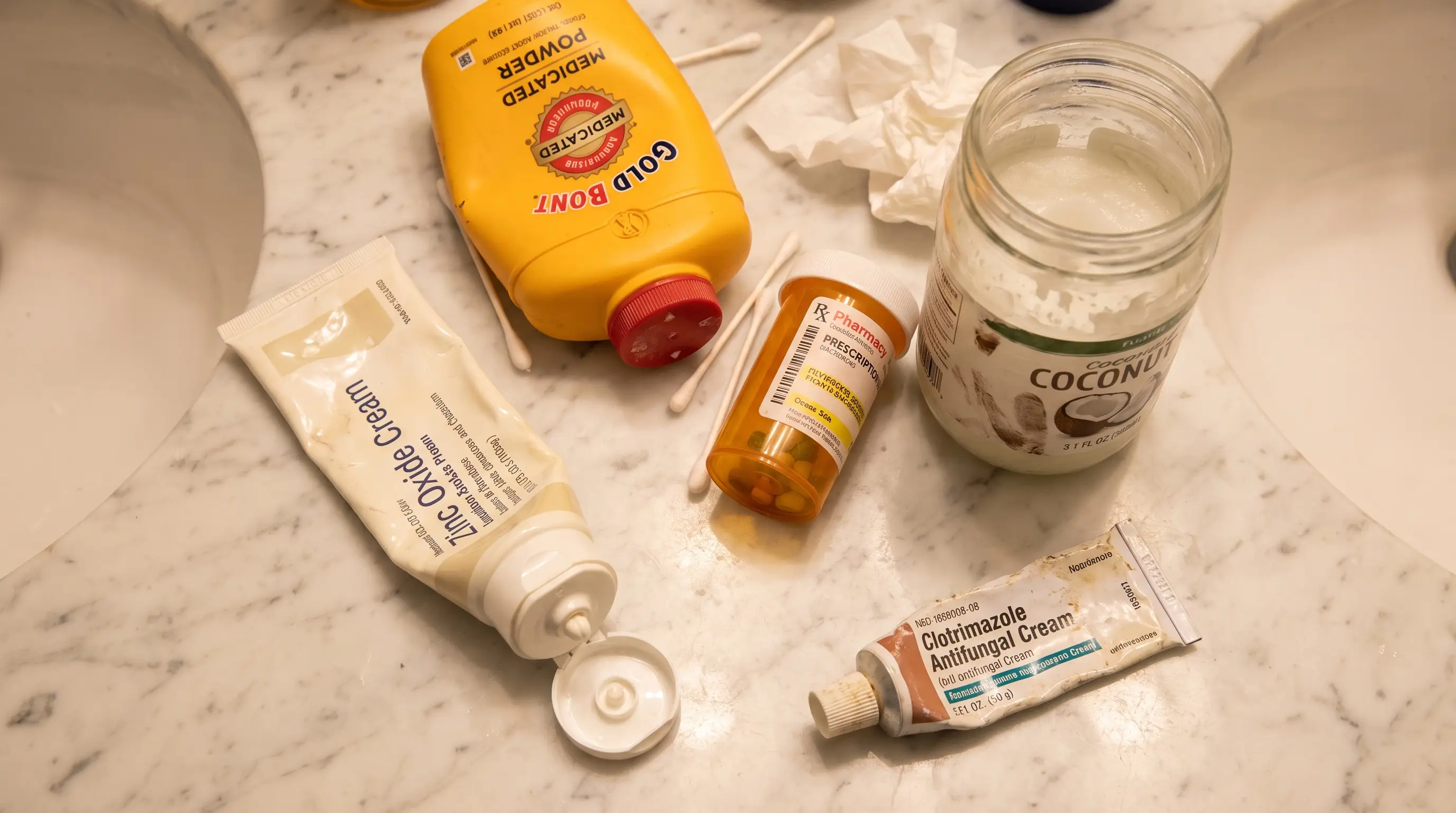
The familiar cycle: baby powder, Desitin, Gold Bond, a prescription tube, coconut oil. Every one designed for exposed skin.
Desitin and zinc-based barrier creams contain zinc oxide, which is a useful barrier ingredient. But Desitin's base is thick petrolatum — an occlusive that seals moisture into the fold. The result: a white paste that transfers to your bra, doesn't wash out, and traps humidity against the skin under a greasy layer.
Coconut oil does the same. It seals moisture in. An occluded fold with coconut oil is warmer and moister than one without it.
OTC antifungal creams — Lotrimin, clotrimazole, miconazole — kill surface-level fungus. This is why they work for a week or two. But their carrier is an emollient base that adds moisture to the fold. The biofilm-protected colony survives. The moist environment persists. The rash returns.
Prescription steroids — triamcinolone, clobetasol — reduce inflammation, which makes the rash appear to heal. But they work by suppressing local immune response. In a sealed fold where the fungus dominates, this removes the body's remaining defense. The rash returns stronger when the prescription ends.
Every one of these was designed for exposed skin. A surface that breathes. A skin fold doesn't breathe. It needs something fundamentally different.
"The moisture-trapping effect of emollient-based antifungals in occluded folds is well-documented. For patients with recurrent intertrigo, the treatment vehicle itself is perpetuating the cycle. A formulation that transitions to a dry barrier addresses the core environmental failure that creams leave open."
— Joanne Calloway, MSN, APRN, CWCN — Wound Care Nurse Practitioner
Dual-action cream-to-powder formula
The Missing Criteria
What a skin fold actually needs — and why it doesn't exist in the drugstore aisle.
A treatment for skin fold intertrigo needs to do two things at the same time.
First: kill the infection — not just on the surface, but through the biofilm, so the protected colony underneath is reached.
Second: keep the fold dry. Not for 90 minutes. For eight, ten, twelve hours — through a full day, through sweat, through movement — so the fungus can't regrow in the moisture it depends on.
Standard creams do the first but add moisture. Powders attempt the second but fail within an hour. No prescription does both. No drugstore product does both.
What's needed is something that doesn't exist in the traditional treatment playbook: a cream that dries to a powder.
A Different Approach
A cream that dries to a powder. Designed for skin folds.
This is the problem Looma Antifungal Cream was formulated to solve.
Looma uses a dual-action approach designed specifically for sealed skin fold environments:
Kill — Undecylenic Acid 10%
Penetrates the fungal biofilm — the protective barrier that lets Candida survive surface treatments — and eliminates the infection at its source. Not just on the surface.
Protect — Zinc Oxide 15% + Silica-Tapioca Matrix
Transforms from cream to dry powder finish within 60 seconds of application. Creates a breathable, moisture-wicking barrier that stays in place for up to 12 hours — without caking, sliding, or adding moisture to the fold.
The formula also includes witch hazel distillate to draw out surface moisture on contact and microencapsulated tea tree oil for slow-release antimicrobial protection over 24 hours.
It applies like a cream. It dries like a powder. It stays where you put it. Nothing transfers to your bra. No reapplication at midday. No residue.
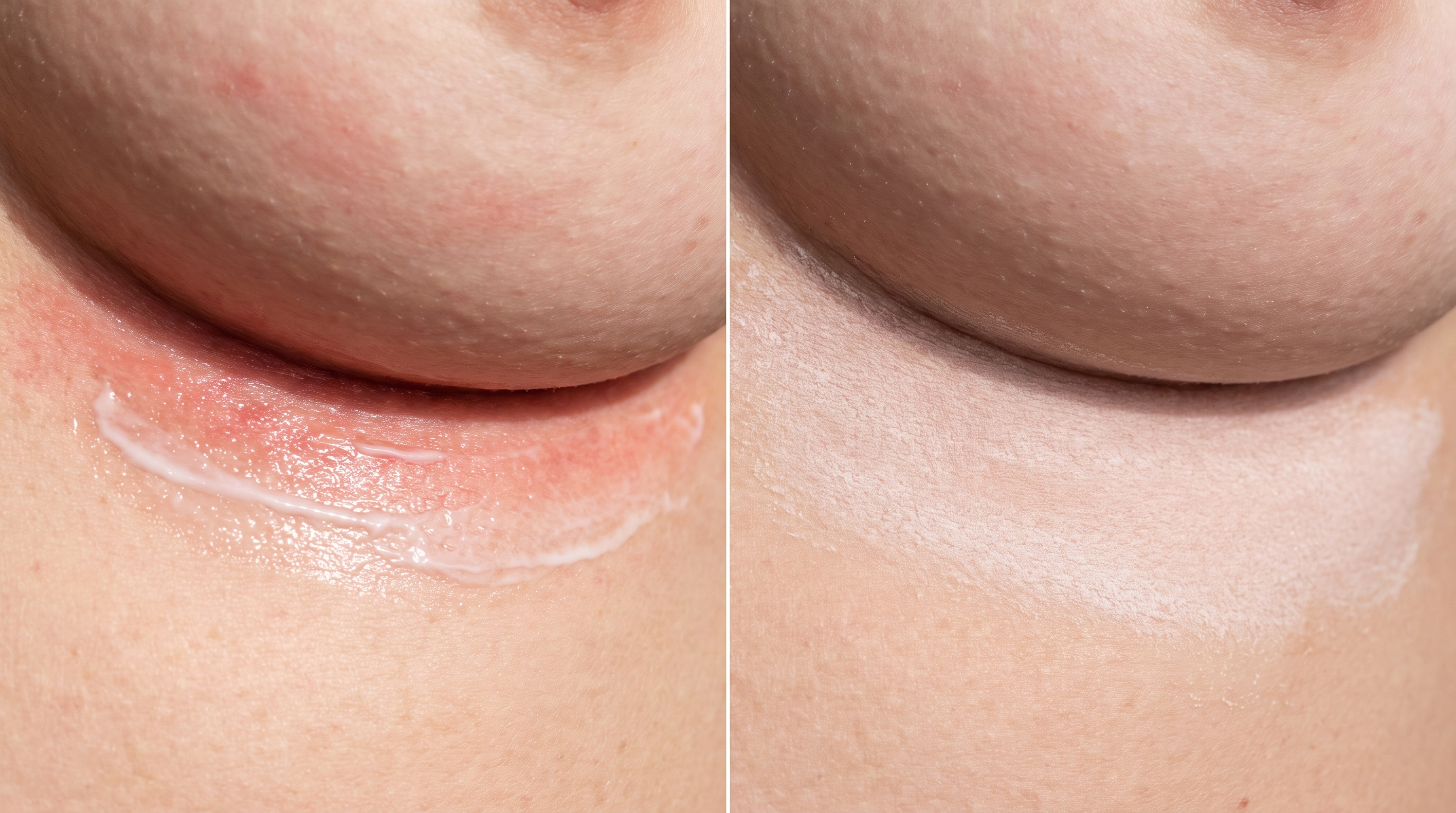
Left: cream at application on irritated skin. Right: dry powder finish after 60 seconds.
Free shipping · 60-day guarantee
Application
Three steps. Sixty seconds.
Clean & dry
Wash the area with a gentle cleanser. Pat completely dry — no residual moisture in the fold.
Apply a thin layer
A small amount covers a large area. Spread evenly across the fold and surrounding skin.
Wait 60 seconds
The cream transforms into a dry, smooth powder barrier. Dress normally. One application lasts up to 12 hours.
What users are reporting
Three women. Years of wrong products. A different outcome.
Thousands of women across the US have tried Looma. Here are three of their experiences.

"I'd been calling it a heat rash for three years."
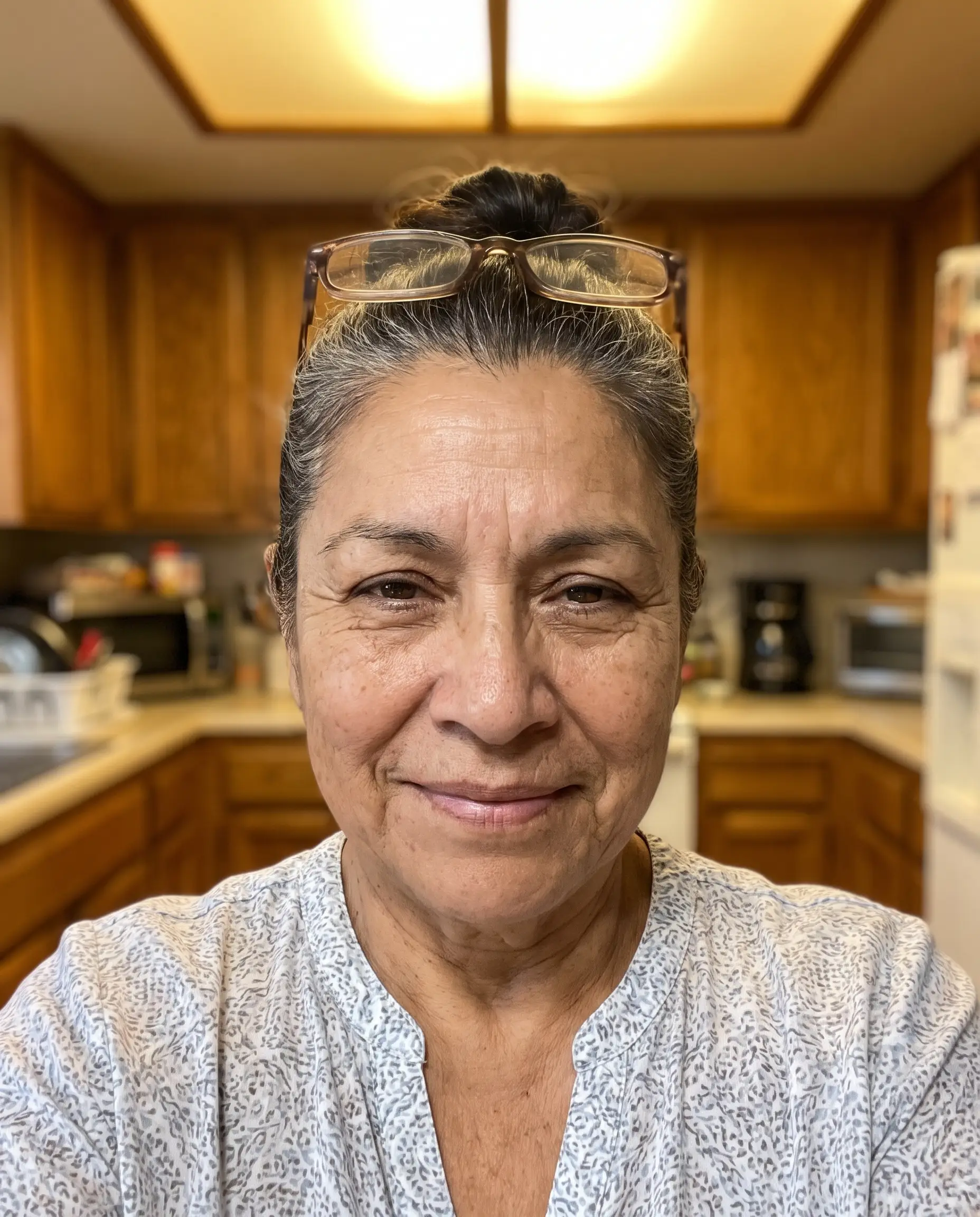
"Baby powder every morning. Nobody told me it was fungal. With Looma I saw improvement by day five. Clear at seventeen. I hugged my granddaughter without pulling away for the first time in years."
Karen M. Portland, OR
"I tried Desitin, Gold Bond, and two prescriptions."
"Four years. Nobody told me it was an infection. The rash was gone in three weeks with Looma. I stopped carrying wet wipes in my purse."
Patricia D. Tucson, AZ

"It wasn't my body. It was the cream."
"Post-weight-loss loose skin created new folds. Rash appeared at 44. I blamed myself for three years. Clear in 19 days with Looma."
Denise K. Charlotte, NC
★★★★★ 4.8/5 verified rating

Looma Antifungal Cream
Dual-action cream-to-powder formula. Kills the infection. Keeps folds dry for 12 hours.
Low Stock — high demand this season
Check Availability →Common Questions
Will it stain my clothing or bra?
No. Looma dries to a clear, powder-like finish within 60 seconds. Once dry, it does not transfer to fabrics.
How long does one tube last?
A single tube lasts most users 4–6 weeks with daily application to one or two areas. A small amount covers a large surface.
Can I use it on skin folds other than under the breasts?
Yes. Looma is formulated for any area where skin folds create a warm, moist environment — under the breasts, between the thighs, beneath the abdominal apron, or in the groin crease.
Is it safe for daily, long-term use?
Looma is designed for both active treatment and ongoing prevention. Many users continue applying it once daily after their rash clears to keep the fold environment dry and protected.
60-day money-back guarantee
Reader Discussion (7)
I had this for SIX YEARS and didn't know it was fungal. I was using cornstarch every single day. CORNSTARCH. I was literally feeding it. I want to scream. One month on Looma and my skin is clear for the first time in years. I am so angry nobody told me sooner.
The part about creams adding moisture to the fold — that's the thing that finally clicked for me. I've been smearing Lotrimin in there for TWO YEARS wondering why it kept coming back. Week 2 of Looma and the rash is almost gone. Cautiously optimistic for the first time.
Just ordered a second tube for my sister. She's been dealing with the same thing and won't talk to her doctor about it. Sending her this article too because the part about it not being a hygiene thing — she needs to read that.
How long does shipping usually take? I'm in Ohio.
Hi Tammy! Most orders arrive within 3–5 business days. You'll get a tracking number as soon as it ships.
I thought it was because of my weight. I thought if I just lost 30 pounds it would go away. Reading that thin women get it too, that it's the FOLD not the body — I actually cried. I've been ashamed of this for five years. Thank you for this article.
Using it since March preventively. Used to get the rash every spring like clockwork. This year — nothing. The powder finish is unusual at first but you get used to it fast. I apply after my shower and don't think about it again until the next morning.
Does this work for the rash I get between my thighs too? Same thing — red, burns, smells, nothing works.
Hi Rhonda — yes, Looma is formulated for any skin fold area. Many of our users apply it under the breasts, between thighs, and in other fold-prone areas. Same mechanism, same results.
Individual results may vary. Testimonials reflect personal experiences and are not guaranteed outcomes. This article is for informational purposes and does not constitute medical advice, diagnosis, or treatment. Looma Antifungal Cream is an over-the-counter topical product. Consult a healthcare provider for persistent or severe skin conditions. This website is an advertisement. The publication name used on this page is fictional and for editorial presentation purposes only.